
Wyoming Car Seat Laws
Car seat laws aim to ensure that children are protected if they’re involved in an accident. However, these laws can vary from state to state, making it complicated for parents to know whether they’re following the right regulations or not.
To make sure that you’re protecting your child’s well-being, while also respecting Wyoming’s laws, there are some crucial regulations to be aware of. Learn more about Wyoming car seat laws and why they could play a role in a claim if you are in a collision.
Understanding Wyoming’s Car Seat Laws
In Wyoming, car seat laws apply to every child who is not yet 9 years old. All drivers and private passenger vehicles must adhere to these regulations. That includes non-residents, so if you are traveling into Wyoming, you must ensure that you have the appropriate car seats when you cross the state border.
Infants who are younger than 1 year and under 20 pounds need to travel in infant-only or rear-facing seats. The harness straps should sit at or below shoulder level. You should never place an infant in the front, even in a rear-facing seat. Airbag deployment could cause severe injuries.
Children between the ages of 1 and 4 who weigh between 20 and 40 pounds should sit in a forward-facing car seat with a harness. Harness straps need to be at or below shoulder level. Keep in mind that the majority of convertible seats require a top slot for the forward-facing setup.
Children over 40 pounds need a belt positioning booster seat that faces forward. They must use both the lap and shoulder belt. This type of seat offers protection for the head.
Children 12 and under should always sit in the back. This protects them in an accident from the force of the deploying airbag.
It’s also recommended that you fill out the car seat’s registration card so that you can be alerted if there is a recall.
Why Correct Car Seat Use Is Essential for Children
Car seat use can significantly reduce the risk of a child suffering a fatal injury. They accomplish this in a number of ways. For one, they absorb a significant amount of the crash force. They are made of specialized materials that can deform in an accident. They also have stability legs to reduce the forward rotation, protecting the child’s head and brain.
Because their bodies are still developing, children can sustain much more severe injuries in accidents. These seats restrain them in a way that won’t cause harm because they target their shoulders and hips, which are the strongest areas. Their abdomens and necks, in contrast, are very fragile, so a regular seat belt could injure them.
A car seat that has been installed correctly can also prevent a child from being ejected from the vehicle in a serious accident. Ejection can lead to catastrophic injuries, even in adults.
Correct car seat use has another very important purpose — it can protect any claim you file after a collision in which your child suffered injuries. Since all private passenger vehicles must have a car seat for children who are under 9 years old, not having one could place some of the blame for your losses on you.
How Wyoming Car Seat Laws Can Affect Personal Injury Claims
Wyoming has modified comparative negligence laws, which allow you to be partly responsible for your losses in a collision and still receive compensation, but if you’re assigned more than 50% of the blame, then you will not be able to recover everything.
You can expect insurance companies to do everything they can to prove that the lack of an appropriate car seat caused your child to sustain their injuries. But does non-compliance with car seat laws always mean that you don’t have a claim?
There are instances when, even if you didn’t have the right car seat, you can still receive compensation. In some cases, you can rely on accident reconstructionist and other expert witnesses to prove that the injuries would have occurred anyway, even if your child was properly secured. That can be the case in severe accidents when the restraint would still not have been enough.
If you are in that situation now after a car accident, it’s vital that you speak with an attorney about your legal options. This is not a process you should pursue on your own because of the risk of not being able to recover losses.











When Is It Time To Contact a Cheyenne Car Accident Lawyer?
After being in a car accident in which your child was not restrained appropriately, you will need to rely on an attorney. Your lawyer will investigate how the accident occurred, which includes speaking with witnesses and contacting medical professionals and accident reconstructionists to see if the injuries would still have occurred if your child had been restrained.
With this information, they can start putting together a claim that shows you still deserve compensation. They’ll begin negotiating with insurance companies, which is one of the most complicated aspects of these cases.
Attempting to go through the negotiation process alone could put you at serious risk of not receiving the compensation your family needs.
Trust Bachus & Schanker With Your Wyoming Car Accident Claim
Being in a car accident is traumatic enough. You don’t need the additional stress of worrying about being seen as liable for your child’s injuries. To protect any claim you file after a collision, you need assistance from experienced attorneys.
At Bachus & Schanker, our team of lawyers provides the comprehensive legal assistance you deserve. We offer confidential and free consultations so that we can understand your situation and you can ask as many questions about the process as you may have.
Since we don’t charge upfront fees, you also don’t need to worry about being able to afford the assistance you need.
Bachus & Schanker, Personal Injury Lawyers | Cheyenne, WY Office
211 W 19th Street, Suite 206
Cheyenne, WY 82001
Open 24/7
#1 Amazon Best Seller in the Legal Industry
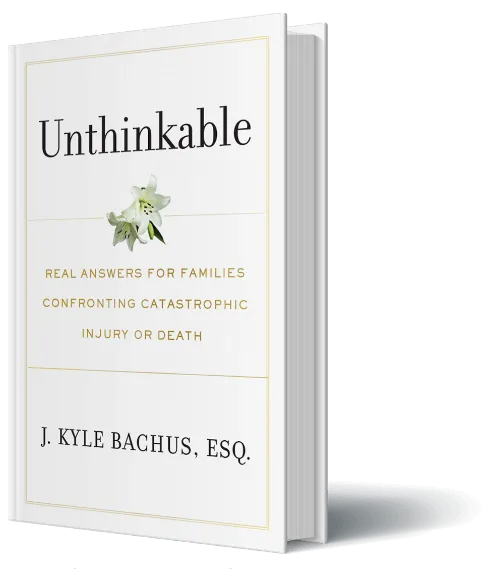
Attorney Kyle Bachus knows first-hand how difficult it can be to suddenly lose a loved one in an accident. It’s also devastating when you or a family member suffers severe injuries that forever change your lives. Kyle wrote this book as a resource from his personal experience for families who have suffered a traumatic loss.
A Spanish edition of the book is also available, offering the same support and guidance to Spanish-speaking families.
You Deserve Fair Compensation
Don’t let the insurance companies intimidate you into accepting less than you deserve. We’re ready to fight for you.